
Imagine cutting your customer service costs while making every call more efficient and accurate. What if your business could handle more calls without needing to hire extra staff or spend hours training new employees?
Automated customer service calls make this possible. By replacing repetitive tasks with smart technology, you save money on labor, reduce errors, and speed up responses. You’ll discover exactly how automating your customer service calls can transform your operations and boost your bottom line.
Keep reading to learn the key ways automation delivers real cost savings for businesses like yours.

Credit: voiceinfra.ai
Automation Cuts Labor Costs
Automated customer service calls help reduce labor costs by handling repetitive tasks. This frees staff to focus on more important work. Errors caused by humans are also lowered, which saves money on fixes. Productivity grows since machines can work faster and without breaks.
Training costs drop too because less time is needed to teach workers. Automated systems are easier to update than training many employees. This means companies spend less on hiring and training new staff. Overall, automation makes customer service more efficient and less costly.
Operational Savings With Automation
Automated customer service calls help cut costs in many ways. Reducing waste lowers expenses on materials and supplies. Automation tracks usage and stops unnecessary spending. It also optimizes supply chains by improving order timing and inventory control. This means fewer delays and less extra stock.
Proactive monitoring prevents downtime by spotting problems early. Machines or systems get fixed before they break, saving repair costs. Less downtime keeps customer service running smoothly and avoids lost sales. Overall, automation saves money by making operations more efficient and reliable.
Data-driven Efficiency Gains
Automated customer service calls help companies save money by making processes faster and easier. Data from these calls improve decision-making by showing clear patterns and customer needs. This helps managers pick the best steps to take.
Automation also keeps companies compliant with rules by recording all calls accurately. This makes audits simpler and ensures laws are followed properly.
Scalable growth is supported because automated calls handle more customers without adding extra staff. This means businesses can grow smoothly without big cost jumps.
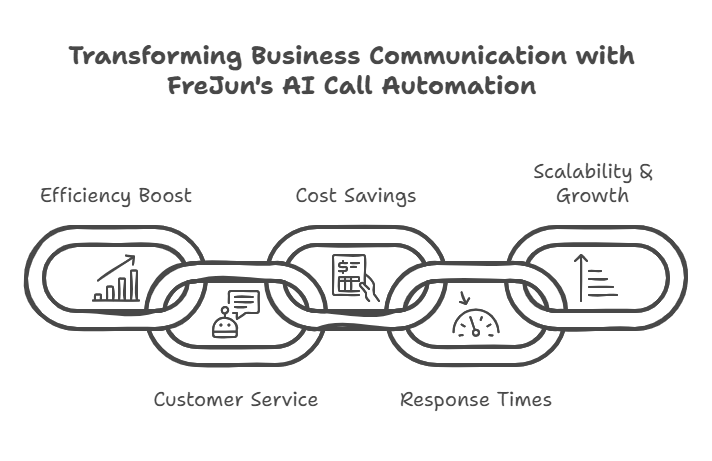
Credit: frejun.com
Maximizing Roi From Customer Service Automation
Balancing cost and quality is key to successful customer service automation. Automation cuts costs by handling many calls without breaks. It also ensures consistent service quality, reducing errors common in human calls. However, too much automation can frustrate customers. A good mix of AI and human agents keeps customers happy and costs low.
Implementing AI for contact centers helps handle routine questions fast. AI bots work 24/7 and never get tired. This lowers wait times and lets human agents focus on complex issues. AI can also gather data to improve service over time.
| Measure | Why It Matters | How to Improve |
|---|---|---|
| Call Resolution Rate | Shows how many calls AI solves fully | Train AI on common questions, update scripts |
| Customer Satisfaction | Reflects how happy customers feel | Mix AI and human support, gather feedback |
| Cost per Call | Tracks spending per interaction | Use automation for simple calls, optimize staffing |
| Call Volume Handled | Measures workload AI manages | Expand AI capabilities, monitor peak times |
Continuous improvement means watching these numbers closely. Small changes can bring big savings. Testing new AI tools and listening to customers keeps service sharp and costs down.

Credit: www.nextiva.com
How Callerr.nl Can Help You with Cost Savings from Automated Customer Service Calls
Practical Learning from Cost Savings in Automated Customer Service Calls
Understanding the cost savings from automated customer service calls opens a gateway to practical learning that extends beyond just reducing labor expenses. By closely examining operational savings and data-driven efficiency gains, organizations can identify where automation drives measurable operational efficiency and immediate ROI.
For instance, leveraging next-generation technologies such as Large Language Models and Natural Language Understanding allows truly intelligent agents to handle 90% call automation with zero wait time. This not only cuts costs but redefines standards for customer experience—offering autonomous excellence at instant scale.
To translate these savings into meaningful business insights, consider tracking how automation impacts both cost and customer satisfaction simultaneously. Exploring integration-focused solutions with zero-code customization can accelerate deployment from days, not months, enabling rapid learning cycles.
- Analyze labor cost reductions alongside operational savings
- Measure efficiency gains through data analytics
- Evaluate the scalability of automation to maximize ROI
If you’re looking to deepen your understanding or explore tailored strategies, connecting with experts familiar with these advanced automation paradigms can be invaluable. Resources like Callerr.nl provide a consultative perspective grounded in technical credibility and results-driven insights.
Frequently Asked Questions
How Does Automation Reduce Cost?
Automation reduces cost by cutting labor expenses, minimizing errors, speeding tasks, lowering waste, optimizing supply chains, and preventing downtime. It also improves data insights and reduces training needs, enhancing overall operational efficiency and saving money.
How To Calculate Automation Cost Savings?
Calculate automation cost savings by subtracting automation expenses from manual process costs. Include labor, error reduction, and efficiency gains. Consider lower training, waste, downtime, and improved decision-making costs for accurate savings estimation.
What Are The 6 Types Of Cost Savings With Examples?
The six types of cost savings include labor reduction (e. g. , automating data entry), minimizing errors (e. g. , accurate billing), increasing output (e. g. , faster production), lowering training costs (e. g. , intuitive software), reducing waste (e.
g. , precise material use), and cutting downtime (e. g. , predictive maintenance).
Can Automation Reduce Costs By 20 30 According To A Mckinsey Study?
Yes, a McKinsey study shows automation can reduce costs by 20-30% by cutting labor, errors, and operational waste.
What Are The Main Cost Savings From Automated Customer Calls?
Automated calls reduce labor, speed up service, and cut errors, lowering overall operational costs.
Conclusion
Automated customer service calls cut costs by reducing labor needs. They help avoid errors that waste time and money. Tasks get done faster, boosting overall productivity. Training costs drop as systems become easier to use. Automation also cuts waste and improves supply management.
Businesses gain steady savings while keeping customers satisfied. This balance makes automation a smart choice for many companies.